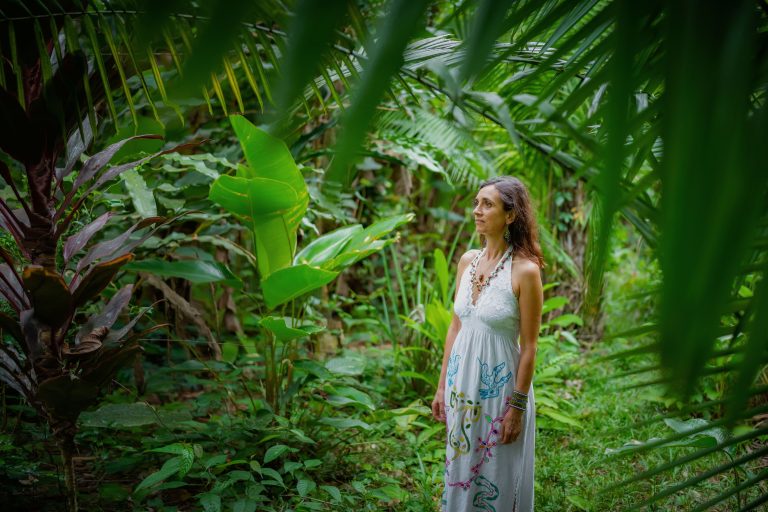
Recently, we received a letter from a guest, David Spivak. In it, he explores the true meaning of “thanking.” He sees it not just as a polite gesture, but as a biological and spiritual necessity. We are honoured to share his reflections on the sacred relationship formed by the vine, the leaf, the Shipibo people, and the Amazon rainforest.
The word “thank” comes from “to think of”. We think of the source from which we received something of value to us, and we return to it in an offering of gratitude.
Everything that persists is a loop, a circuit that returns current to its source. Where current flows and does not return, the source drains out and the system slowly disintegrates. The difference between circuit and drain is the oldest difference in life, and the one life most needs to remember.
Gratitude is not a feeling. It is the linchpin of anything that lasts. It is how a system identifies its circuits and invents ways to reinforce and repair them. A circuit that does not thank its source loses its source. That’s why a watershed has beavers and a cell has DNA-repairing enzymes. A civilization that forgets what sustains it drains to the ground.
But gratitude can be forgotten or blocked. A system can lose track of what has been returning energy to it by mistaking its circuits for background or never learning to recognize them at all. And when that happens, no instruction can repair it. You cannot tell a drain to be a circuit. You cannot argue someone into recognizing what sustains them. You need something that operates deeper than instruction: a way to make the old loops audible again. A force powerful enough to make us cry for help, and accurate enough to show us that what answers is already alive and breathing within and around us.
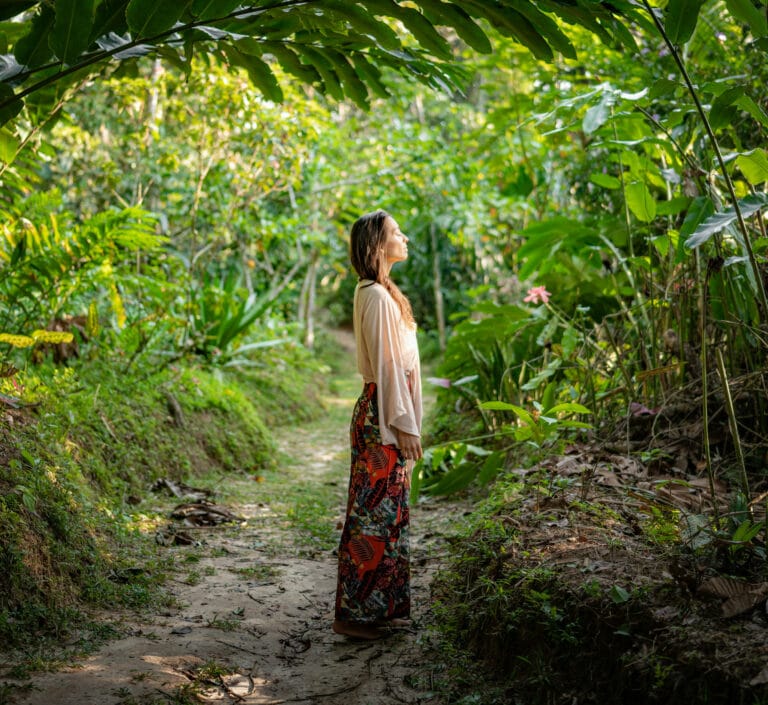
The Amazon basin is the largest intact circuit on Earth. It generates half its own rainfall. The forest breathes water into the sky so the sky can return it as rain. But the forest did not only build a circuit. Over millennia, it built a way to repair the capacity for gratitude itself, and it did this by growing three things that close this circuit only together.
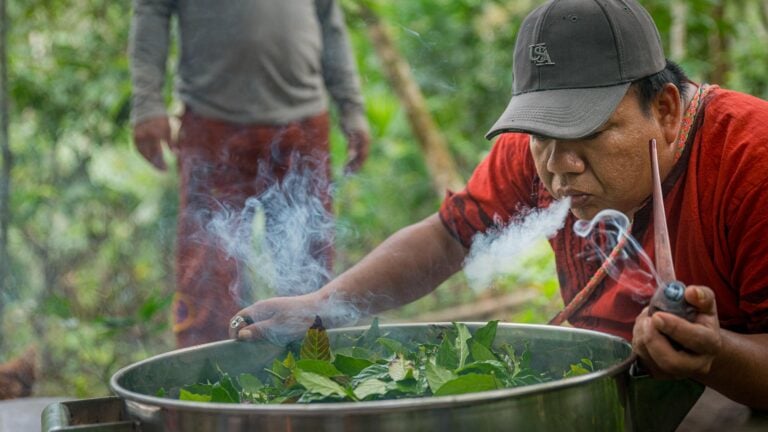
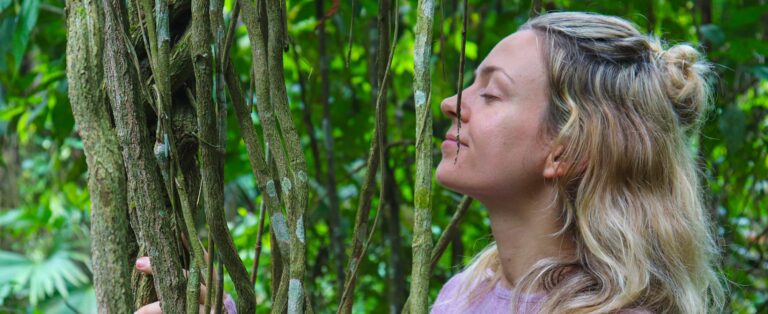
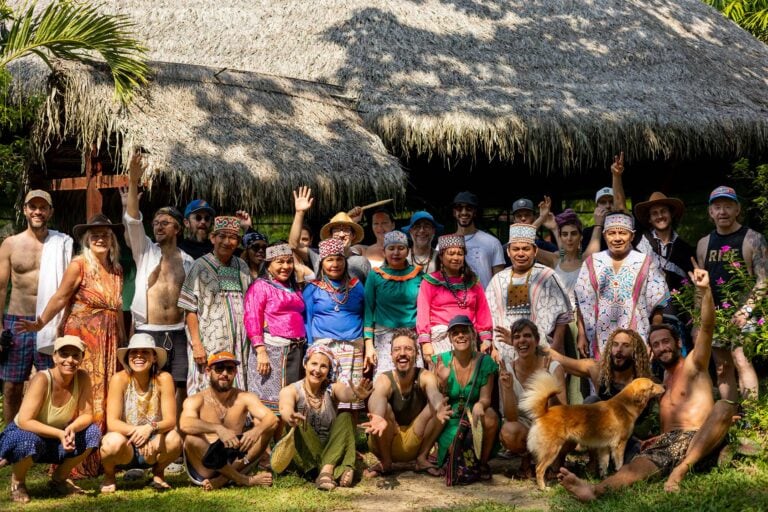
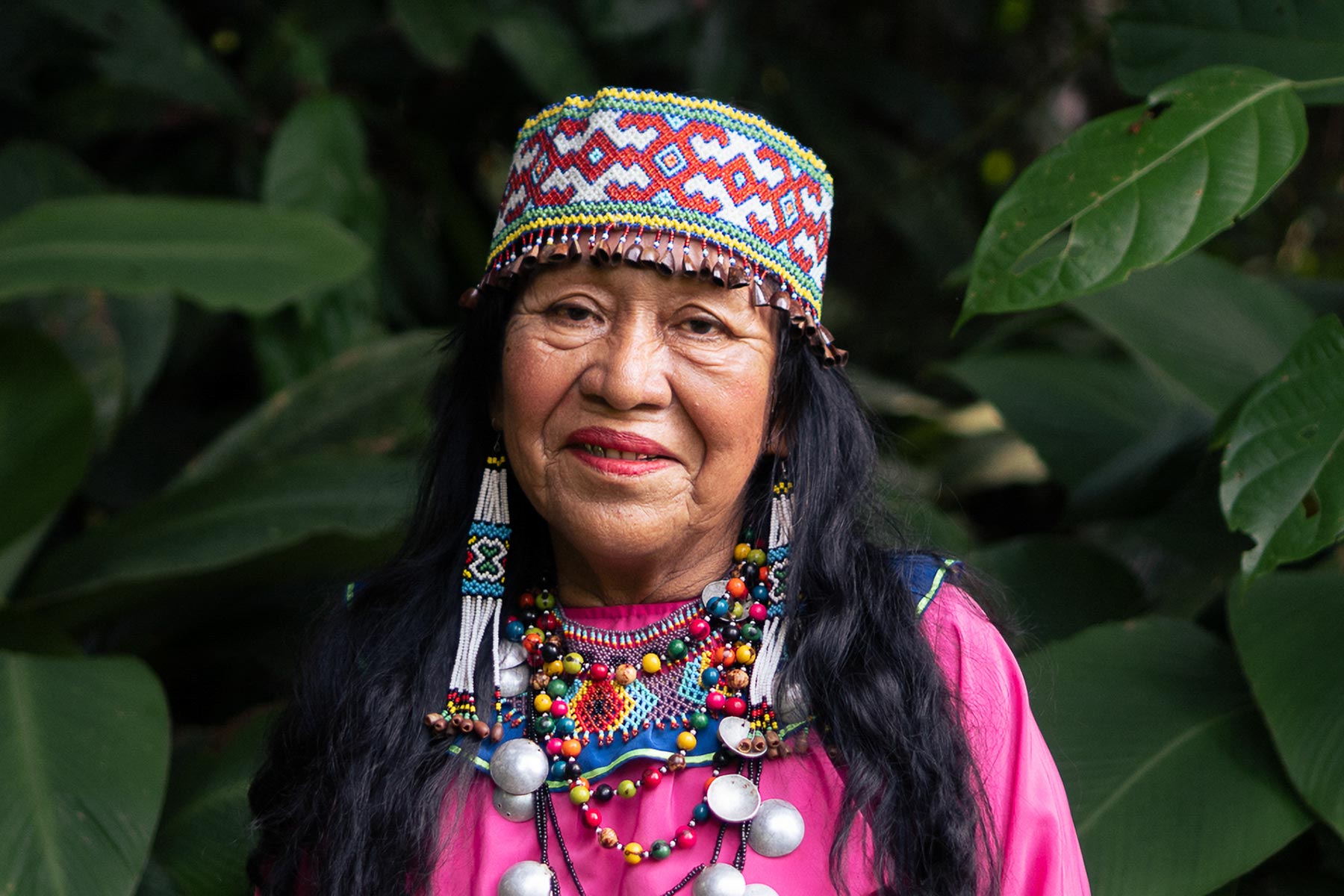
It grew the vine – Ayahuasca – which opens the gate but carries no messenger through it. It grew the leaf – Chacruna – which produces the messenger but cannot open the gate. And it grew a people who learned to combine them – among them, the Shipibo – who were shaped by this forest the way a riverbed is shaped by its river, and who in turn shaped it back: discovering that what neither plant could do alone, both could do together, and building the ceremony, the dieta, the ikaro, the whole living structure through which the combination becomes a technology for profound healing.
These three things each carry their own power – the vine opens, the leaf speaks, the Shipibo tend whole pharmacopoeias of healing plants – yet together complete a circuit none of them closes alone. The vine needs the leaf. The leaf needs the vine. Both need the people who sing. The singers need the song that the plants taught them to sing. No part of this loop can open and restore us by itself.
Ayahuasca taken without the jungle, without the onanya, without the ikaro, is not a simplification or convenience. It is a perversion: the circuit stripped to a molecule and fed to an isolated individual. It takes the forest’s deepest act of collaboration and forces it into the very frame in which the medicine exists to heal – the frame in which a self consumes what it needs alone. The vine opens the gate; the leaf carries the message; the singer finds the channel; and the jungle – alive, dangerous, raining, overpowering, still breathing after all these millennia – holds it all. Remove any one and you have not accessed the medicine more efficiently. You have enacted the disease.
And what the full circuit does is this: it makes the drains unbearable. You come carrying an intention – something specific, something you think is the problem – and the ceremony shows you what stands between you and everything, refracted through the one thing you brought. The patterns that take and do not return: it forces you to feel them in your body, and your body rejects them. You groan, you writhe, and you purge. And as the horrors of your illness pass, what remains is what was always there: the loops that have been returning, quietly, beneath everything. Not discovered, but uncovered, and so much larger than what you came for. And so much simpler: you are alive in this moment, within an ancient living world.
Gratitude is not only appreciating what returns; it is inventing a way to return. And you cannot invent it alone because a loop, by definition, requires what is not you. The forest invented ayahuasca through the collaboration of vine, leaf, and people. The Shipibo invented the ceremony through the collaboration of plant, song, darkness and silence. Each is an act of gratitude: not a response to a gift but the creation of a means of responding. Each is a way to thank thanking.
The Shipibo carry the ikaros: songs that do not perform the healing but find the channel, that remind a disorganized and worried mind where its wholeness already lives. They are holding the slow channel, the one that has run for thousands of years while the fast ones scream and drain. They are holding it for all of us, and we the suffering, we the conquering, we the lost, need them now more than we know.
David Spivak